
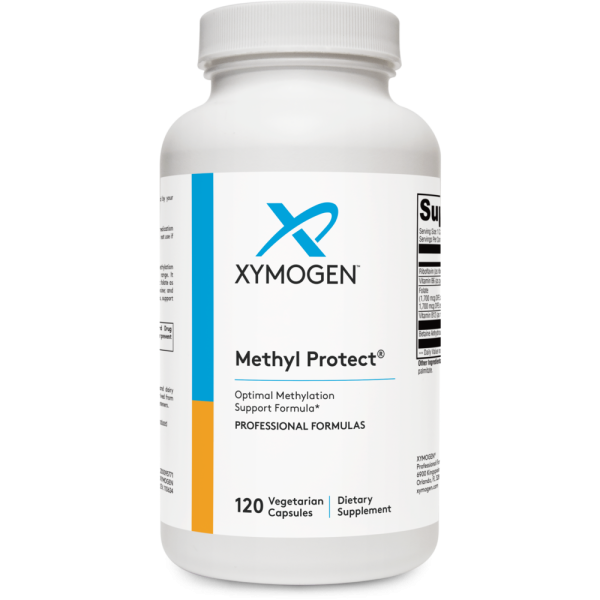
Methyl Protect 120 Capsules
- Clinical Applications
-
- Supports Cardiovascular and Neurological Health*
- Supports the Maintenance of Healthy Homocysteine Levels Already Within Normal Range*
- Supports Healthy Methylation of Estrogen, Dopamine, Epinephrine, Heavy Metals, and Environmental Toxins*
- Description:
-
Methyl Protect® is a comprehensive formula designed to support optimal methylation and help maintain healthy homocysteine levels already within normal range. It features five key nutrients that are involved in homocysteine metabolism: folate as calcium folinate and Quatrefolic® for increased bioactivity; trimethylglycine; and vitamins B12, B6, and B2. These five nutrients, provided in activated forms, support enhanced methylation and overall cardiovascular health.*
- Clinical Applications
-
- Supports Cardiovascular and Neurological Health*
- Supports the Maintenance of Healthy Homocysteine Levels Already Within Normal Range*
- Supports Healthy Methylation of Estrogen, Dopamine, Epinephrine, Heavy Metals, and Environmental Toxins*
- Description:
-
Methyl Protect® is a comprehensive formula designed to support optimal methylation and help maintain healthy homocysteine levels already within normal range. It features five key nutrients that are involved in homocysteine metabolism: folate as calcium folinate and Quatrefolic® for increased bioactivity; trimethylglycine; and vitamins B12, B6, and B2. These five nutrients, provided in activated forms, support enhanced methylation and overall cardiovascular health.*
Supplement Facts
Serving Size: 1 Capsule
Servings Per Container: 120
| Amount Per Serving | % Daily Value | |
|---|---|---|
|
Riboflavin (as riboflavin 5’-phosphate sodium) |
25 mg | 1,923% |
|
Vitamin B6 (as pyridoxal 5’-phosphate) |
10 mg | 588% |
|
Folate |
3,400 mcg DFE | 850% |
|
Vitamin B12 (as methylcobalamin) |
1,000 mcg | 41,667% |
|
Betaine Anhydrous (trimethylglycine) |
500 mg | ** |
Take one capsule one to two times daily, or as directed by your healthcare professional.
Homocysteine Lowering: The Role of Trimethylglycine, Methylated Folate, and B Vitamins (Riboflavin, B6, and B12)
Homocysteine is an amino acid derived from methionine metabolism. Elevated homocysteine levels have been linked to various health issues, including cardiovascular disease, stroke, osteoporosis, and neural tube defects. To maintain optimal health, it is essential to regulate homocysteine levels in the blood. Trimethylglycine (TMG), methylated folate, and B vitamins (riboflavin, B6, and B12) play crucial roles in homocysteine metabolism and can help reduce homocysteine levels.
1. Homocysteine Metabolism and its Regulation
Homocysteine is metabolized through two primary pathways:
- Remethylation: Homocysteine is converted back to methionine, primarily in the liver. This process requires folate, vitamin B12, and methylcobalamin as cofactors.
- Transsulfuration: Homocysteine is converted to cysteine, which is then used to produce glutathione, a potent antioxidant. This pathway requires vitamin B6 as a cofactor.
2. Trimethylglycine (TMG)
TMG, also known as betaine, is a methyl donor involved in the remethylation of homocysteine to methionine. By donating a methyl group, TMG helps lower homocysteine levels and supports overall methylation processes in the body.
- Action: TMG donates a methyl group to homocysteine, converting it to methionine and lowering homocysteine levels.
- Dosage: The typical dosage for TMG supplementation to lower homocysteine is 1,000-3,000 mg per day.
3. Methylated Folate
Folate (vitamin B9) is a crucial cofactor in the remethylation of homocysteine to methionine. Methylated folate, such as 5-methyltetrahydrofolate (5-MTHF), is the active form of folate and is more bioavailable than synthetic folic acid. Methylated folate helps lower homocysteine levels by supporting the methylation process.
- Action: Methylated folate accepts a methyl group from vitamin B12, allowing it to participate in the remethylation of homocysteine.
- Dosage: The typical dosage for methylated folate supplementation to lower homocysteine is 400-800 mcg of 5-MTHF per day.
4. Riboflavin (Vitamin B2)
Riboflavin is a cofactor in the enzyme methylenetetrahydrofolate reductase (MTHFR), which converts folate to its active form, 5-MTHF. By supporting MTHFR activity, riboflavin helps maintain optimal folate levels and promotes homocysteine lowering.
- Action: Riboflavin supports the activity of MTHFR, ensuring adequate levels of active folate for homocysteine remethylation.
- Dosage: The typical dosage for riboflavin supplementation to support homocysteine lowering is 1.3-1.7 mg per day.
5. Vitamin B6 (Pyridoxine)
Vitamin B6 is a cofactor in the transsulfuration pathway, which converts homocysteine to cysteine. By supporting this pathway, vitamin B6 helps lower homocysteine levels and promotes overall sulfur metabolism.
- Action: Vitamin B6 supports the transsulfuration pathway, converting homocysteine to cysteine and lowering homocysteine levels.
- Dosage: The typical dosage for vitamin B6 supplementation to lower homocysteine is 2-25 mg per day, with the upper limit set at 100 mg per day to avoid potential nerve damage.
6. Vitamin B12 (Cobalamin)
Vitamin B12 is an essential cofactor in the remethylation of homocysteine to methionine. Methylcobalamin, the active form of vitamin B12, donates a methyl group to folate, allowing it to participate in the methylation process and lower homocysteine levels.
- Action: Methylcobalamin donates a methyl group to folate, enabling the remethylation of homocysteine.
- Dosage: The typical dosage for methylcobalamin supplementation to lower homocysteine is 1,000-2,000 mcg per day.
Product Reviews
No reviews available for this product.
