
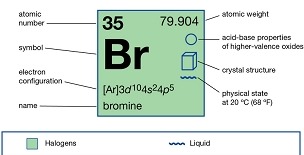
The periodic table is made up of families. Each element in a family has similar properties but is unique in its own way. The halogen family is comprised of Iodine, Bromine (Bromide is the reduced form), Fluorine, and Chlorine (and a few others). While Iodine has many benefits in the body, Bromide competes for binding sites and is very detrimental to the absorption of Iodine.
Being in the same family, the atomic make up of Iodine and Bromide is very similar. If a person’s body is not saturated with Iodine, Bromide can trick the binding sites into thinking it is Iodine. Since Iodine and Bromine compete with one another for absorption and receptor binding, the body can only eliminate Bromine if there is sufficient Iodine available. Bromide is rapidly absorbed in the intestinal tract and has a long half-life. Once bound to a cell, it can occupy the body for years. The normal half-life of Bromide is 12 days and in cases of salt restriction and chronic Bromide exposure, the half-life of Bromide can be as high as 45-50 days. Bromide adversely affects Iodine utilization.
The national average for Bromide is 1-2mg/24 hour. Based on research, Bromide values of 5mg/24 hour cause drastic exponential issues. However, any level of Bromide should be addressed. Possible symptoms of Bromide toxicity or Bromide detox include: headaches, brassy or metallic taste in the mouth, and skin rash tend to be the most common.
Coupling the Bromide analysis with Iodine, provides key insights of whole body Iodine sufficiency or deficiency.