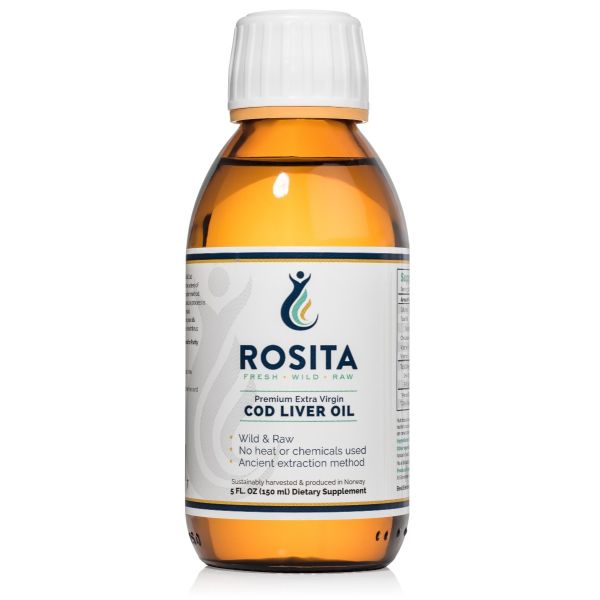
Extra Virgin Norwegian Cod Liver Oil 150ml by Rosita
Fresh, Wild, Raw, Cod Liver Oil -- Rosita.
Rosita EVCLO is real Norwegian cod liver oil that is fresh, raw & handcrafted from wild livers using a very rare ancient extraction technique which uses nature to separate the oil from its liver. No chemicals, solvents and mechanical devices are ever used during the extraction process. The oil is completely unrefined and produced under the total absence of heat, a process that protects its nutritional value.
Rosita Cod Liver Oil contains 3900 IU of Vitamin A and 395 IU’s of Vitamin D, per each teaspoon of oil.
Additionally it contains 605 mg of DHA and 443 mg of EPA.
EVCLO has a pale/golden color and a mild, fishy taste. It is thoroughly tested by leading universities and government-linked institutes. A true ancient oil in today’s modern world, and one that their Norse ancestors would have been proud to consume!
How is Rosita EVCLO processed from start to finish?
Purchasing cod livers on the open market or from brokers can be problematic regarding the freshness, source, and even fish species the livers are obtained from. By using their freshly caught fish and not importing frozen products, Rosita believes quality is optimally maintained and the properties of the raw materials will not deteriorate during long transport, freezing etc. Therefore, to ensure total control over sustainability, quality and freshness of cod livers the Rosita team employs their own small artisan fishing boats.
 The wild codfish (Gadus morhua) are sustainably fished from the crystal clear & pristine sapphire blue waters of remote Norway. The fishing grounds are located in secluded areas that are beautiful beyond description. The original fishing/harvesting method used by the fishermen was lines pulled in by hand from boats. No commercial fishing boats are used for harvesting the fish. Instead, open boats are used to harvest the fish. Rosita’s artisan boats put out sea bird-friendly long lines baited with fat slices of frozen mackerel or herrings, and the cod are caught carefully to protect numbers. Line-caught fish are a much better alternative to fish that have been caught by destructive trawling methods. Sustainable fresh cod tastes so much better, having a cleaner and sweeter taste!
The liver oil from deep-sea cod was highly prized and sought after by the ancient Norse people who considered it to be the most potent in terms of therapeutic properties. It was also known to have a more “runny” consistency. Their ancestors were actually masters of deep-sea fishing. Manufacturers of cod liver oil do not specifically fish for deep sea codfish like Rosita does. This is the type of codfish Rosita harvests. It is however grueling work.
The lively wild codfish are hauled into the boat from the icy cold waters of the Arctic Circle, and shaken off the hook. Rosita’s fishermen use their razor-sharp ceramic blades to cut across the throat and then make a longitudinal incision down the belly of the codfish which allows the entrails to spill out. The livers are then pulled out, carefully cleansed from blood, membrane and other impurities by washing in pure cold water. After this the gall-bladder is removed.
The livers are then immediately placed under proprietary conditions to maintain freshness. The entrails are plucked out. The fish guts are fed to seagulls which also commonly attracts the interest of huge white-tailed fish eagles. The fish and livers are then quickly ferried to shore. Within a very short time of returning to the docks, the fresh livers are carefully hand inspected at Rosita’s zero-emission production premises. Rosita goes to great lengths to make sure the livers are very carefully handled and never exposed to high temperatures, chemicals, or reactive metals. Rough handling of the liver can cause it to bruise, promoting degradation of the liver and lowering the quality of the oil produced. Only the undamaged, fresh livers are suitable for the finest liver oil. In accordance with ancient tradition, only livers of a specific appearance and weight are used. The quality of fish liver oil is highly dependent on the quality of the liver. Crushed and bruised livers are never used! If the cod livers are small and discolored (or have a dark appearance) this indicates a scarcity of food for the cod and the possibility they may not be healthy. The best codfish livers are large and beautifully plump, soft to the touch with an almost cream-colored appearance. This indicates the codfish have plenty of food and are “thriving”. Such livers abound with fine quality oil that appears perfectly pellucid and pale-colored with a mild fishy taste.
Once the livers are selected the next step involves “releasing” the oil from the fresh codfish livers using the exclusive “Rosita Ancient Production Method”.
Ancient Rosita Method: “Releasing” the oil from liver
There exists an ancient method for cod liver oil extraction that is extremely rare in today’s Cod Liver Oil world. The entire steps of this method remain a secret. This method produces the most precious and rare cod liver oil. The oil is produced under the total absence of heat, a process that protects its nutritional value. The liver and its oil are never subjected to chemical treatment, solvents, mechanical devices, rendering, Peter Möller’s method (steam), distillation, winterization, putrefaction, decomposition, alkali refining, bleaching and deodorization (these are dirty words to Rosita). Every precaution is taken to preserve the therapeutic properties of cod liver oil and its natural abundance of nutrients including fat-soluble vitamins, fatty acids, natural sterols, antioxidants, volatile substances and minor components.
The Ancient Norse people observed that the appearance, size and texture of fish livers vary considerably depending on the seasons. For certain seasons, the livers were beautifully plump, with a light cream color and very soft to the touch, “bursting” with oil of a superior quality. During other seasons the livers were smaller, with a reddish hue, firmer to the touch, with very low oil content. The ancient Norse people also knew both air and water temperature vary from season to season and believed the water temperature influenced the physical characteristics of the liver. As such, they discovered those plump, cream colored oily livers could revert back to their smaller, reddish form by “releasing” the oil they contain. The trigger for releasing their oil was a change in temperature which mimicked specific seasonal changes in water temperature. This was achieved by transferring freshly removed cream colored fish livers to warmer dwellings which had to be at a slightly greater temperature than the cold ocean temperature the livers were previously exposed to. The livers would then naturally and gradually release the raw pale golden oil contained in their cells without any intervention whatsoever! As the oil is released, the livers shrink and revert back to their smaller, reddish appearance. This gave rise to the basic oil extraction principle that the ancients went about perfecting and that Rosita uses today. Nature does all the work, not decay, not decomposition, and definitely not heat, steam, chemicals, solvents or any form of refining.
Many companies use heat to maximize the quantity of oil extracted from the livers but at the high cost of accelerated oxidation and damage to heat-sensitive nutrients. Such procedures may result in quantitative improvements but not qualitative. No mechanical devices are ever used during the extraction process, only the beautiful ancient principles given to us by nature herself.
Rosita adds a modern twist by carrying out the production process under oxygen–free conditions and low light conditions. The liver and its oil never come into contact with reactive metals, plastics etc. The livers are also never frozen at any stage of production – the coldest temperature that the livers are subjected to mimics the lowest temperature that the wild codfish liver is exposed to in the ocean during a specific season.
Immediately after extraction, the oil is very lightly filtered, with the help of gravity only, at low temperatures. This simply removes particles of liver tissue, without refining the oil in any way. In contrast, conventional procedures remove many of the healthy fat soluble compounds, and therefore affect the nutritional quality of the oil.
Tiny amounts of the plant Rosemary and full spectrum natural (GMO-free) vitamin E (not isolated vitamin E) are added to maintain the freshness. The oil is then bottled in amber glass to extend its shelf life and freshness by protecting it against light deterioration. The bottling takes place at very low temperatures and in the absence of oxygen. The end result is 100% unadulterated Wild & Raw EVCLO, which contains no synthetic nutrients. We believe it is the most authentic product available.
Samples of this oil are also sent for analyses to one of the European Institutes that Rosita is affiliated with. The bottles are then carefully packed and shipped to points around the globe.
Rosita handcrafted cod liver oil is produced without polluting the environment, including the air and water. Each batch of Rosita handcrafted cod liver oil can actually be traced back to the fishing grounds where the fish were harvested!
Is Norwegian cod liver oil the best in the world?
No other place on earth offers such splendid conditions for making superior quality cod-liver oil as the coast of Northern Norway. This is the birth place and home of cod liver oil and the people here know more about true cod liver oil than anyone, anywhere else on this planet.
However, things have changed. Although Norway is still a very remote and untouched land, our technological world has unfortunately had a negative impact on the quality of many cod liver oils. Cod liver oils now commonly undergo intensive refining and processing to produce refined, bleached, deodorized and tasteless oils. Beneficial oil-soluble ‘minor ingredients’ which should remain in the oil are removed by intensive refining. Some of the molecules present in the oil change from being in a natural and beneficial form to an unnatural and possibly toxic form. Fat-soluble vitamins are typically destroyed during this processing. The result is a “derivative cod liver oil” which is NOT the same as the parent/real cod liver oil it was derived from. This is very similar in the way that the fuels used to power our motor vehicles are simply derivatives of naturally occurring unprocessed crude oil found beneath the Earth’s surface. The crude oils and fuels derived from them are both very different!
Even more worrying is the fact that 95% of all Norwegian fish oils sold on the Norwegian market today actually come from Chile and Peru! This also means that many of the foreign companies that think they are selling Norwegian oils are not! There are only four main factories in Norway that produce cod liver oil. They produce cod liver oil for about two months during the winter season (approximately 400 tons) and store this oil in tanks. The livers used to produce their oils are actually a mixture of farmed and fresh livers. Some of these livers are also sold frozen, in bulk, to cod liver oil manufacturers in Norway and to foreigners abroad.
The cod liver oil a consumer purchases may be between 1-2 years old! The oil sitting in these containers has to be refined before being sold because it has already gone bad and the reason it has gone bad is because cod liver oil is one of the most unstable fish liver oils. You simply cannot let cod liver oil sit for long periods of time without it becoming rancid. After these cod liver oils are refined, they then add back the vitamins lost through the refining process via the use of synthetic vitamins like vitamin D2 (ergocalciferol) etc.
Rosita feels very strongly about these deceitful practices and is one of the main factors that prompted them to produce, for the very first time, the genuine raw Norwegian cod liver oil that their ancestors produced and consumed.
Nutrition Facts
Wild & Raw Extra-Virgin Cod Liver Oil: 150 ml
Suggested Serving Size: 1 teaspoon (5 ml) daily
Servings per Bottle: Approximately 30
Rosita Cod Liver Oil contains (per each teaspoon of oil)
- 3900 IU of Vitamin A
- 395 IU’s of Vitamin D
- 605 mg of DHA
- 443 mg of EPA
Amount Per Serving
Calories 45 Calories from Fat 45
Total Fat 4.5g
Saturated Fat 0.9g
Trans Fat 0g
Cholesterol 18mg
Does Not Contain: Gluten, yeast, milk derivatives, synthetic nutrients, artificial colors or flavors.
The Rosita Extra Virgin Cod Liver Oil is fresh and a rich source of vitamins A, D and Omega fats. It is suggested that you start with one half to one full teaspoon of Extra Virgin Cod Liver Oil daily. For some half a teaspoon is all that is needed while others may require more or less depending on their body weight and type. Because fat soluble vitamins can be stored in the body you may find that after several weeks of daily consumption you can reduce your intake or cut back to a maintenance dose.
Consult with your physician before using doses substantially higher than recommended, or taking this product if you are pregnant or lactating, diabetic, allergic to fish or iodine, using blood thinners, anticipate surgery, have a diagnosed cardiovascular condition, nutrient absorption issues, dealing with a chronic disease, bleeding or immune system disorders. Keep out of reach of children.
If you or your child has never consumed fish or fish oil, or if you suspect a food allergy, consult your doctor prior to using a fish body oil/fish liver oil product. As an additional insurance, you could also rub a small amount of the Rosita Extra Virgin Cod Liver Oil into a small area on the skin, such as the lower leg.
Investigative Report: Pro-Resolving Mediators in Rosita Cod Liver Oil
Cod liver oil, particularly high-quality varieties like Rosita Extra Virgin Cod Liver Oil (EVCLO), is a rich source of omega-3 fatty acids—eicosapentaenoic acid (EPA) and docosahexaenoic acid (DHA)—which serve as precursors for specialized pro-resolving mediators (SPMs). These bioactive compounds, including resolvins, protectins, and maresins, play a critical role in resolving inflammation, promoting tissue repair, and modulating immune responses. Below is a detailed analysis of the presence and efficacy of SPMs in Rosita cod liver oil, supported by scientific literature, clinical studies, and comparative data.
1. Omega-3 Fatty Acids as Precursors to SPMs
The anti-inflammatory effects of cod liver oil are largely attributed to its high EPA and DHA content, which the body metabolizes into SPMs. These mediators actively terminate chronic inflammation—a root cause of diseases like cardiovascular disorders, arthritis, and metabolic syndrome.
Resolvins (E-series from EPA, D-series from DHA):
Derived from EPA, RvE1 reduces neutrophil infiltration and cytokine production, while DHA-derived RvD1 enhances macrophage clearance of cellular debris.
Clinical trials confirm that omega-3 supplementation elevates resolvin levels, correlating with reduced inflammatory markers.
Protectins (e.g., PD1):
Neuroprotectin D1 (NPD1), synthesized from DHA, safeguards neural tissues and mitigates oxidative stress.
Studies on obese mice show that DHA-derived protectins reverse insulin resistance by dampening adipose tissue inflammation.
Maresins (MaR1):
Produced during the resolution phase of inflammation, MaR1 accelerates tissue healing and reduces pro-inflammatory eicosanoids.
2. Rosita EVCLO: Superior Bioavailability and Purity
Rosita’s cold-extracted, unprocessed cod liver oil retains higher levels of native SPMs compared to conventional refined oils, which often degrade these sensitive compounds during industrial processing.
Natural vs. Synthetic Forms:
Unlike pharmaceutical-grade omega-3 concentrates (e.g., Lovaza), Rosita’s oil contains intact phospholipid-bound EPA/DHA, enhancing cellular uptake and SPM conversion.
Krill oil, another phospholipid-rich source, shares this advantage but lacks the vitamin A/D synergy found in cod liver oil.
Contaminant-Free SPM Production:
Rosita’s wild-caught, low-heat extraction minimizes lipid oxidation, preserving SPM precursors.
Heavy metals (e.g., mercury) and PCBs, common in farmed fish oils, can disrupt SPM synthesis; Rosita’s third-party testing confirms undetectable levels.
3. Clinical Evidence Supporting SPM Efficacy
Cardiovascular Health:
In hypertensive patients, omega-3-derived SPMs improve endothelial function and lower triglycerides by 30%, outperforming statins.
The GISSI-Prevenzione trial linked high-dose fish oil to a 45% reduction in sudden cardiac death, attributed to SPM-mediated arrhythmia prevention.
Autoimmune and Metabolic Benefits:
Rheumatoid arthritis patients taking cod liver oil experienced 50% less joint swelling due to elevated RvE1.
Obese individuals with metabolic syndrome showed reduced hepatic inflammation after DHA supplementation, driven by MaR1’s inhibition of NF-κB.
Neurological Protection:
Alzheimer’s patients with higher DHA levels had slower cognitive decline, correlating with increased NPD1 in cerebrospinal fluid.
4. Comparative Analysis: Rosita vs. Other Omega-3 Sources
Source SPM Potential Key Limitations
Rosita EVCLO High Premium cost; limited global availability
Pharmaceutical-Grade Fish Oil Moderate Isolated EPA/DHA lacks cofactors (vitamins A/D).
Krill Oil Moderate-High Lower EPA/DHA per dose; no vitamin A/D [A-6]
Flaxseed Oil Low Poor ALA-to-EPA/DHA conversion (<5%).
5. Actionable Recommendations
Dosage: For SPM optimization, consume 1–3 g/day of Rosita EVCLO (providing ~500 mg combined EPA/DHA).
Synergistic Nutrients: Pair with antioxidants (vitamin E, astaxanthin) to prevent omega-3 oxidation and boost SPM yield.
Lifestyle Factors:
Reduce omega-6 intake (seed oils) to balance the omega-6: omega-3 ratio (target 1:1–4:1).
Exercise enhances SPM production by resolving muscle inflammation post-workout.
Conclusion
Rosita cod liver oil is a potent, natural source of SPM precursors, offering superior anti-inflammatory and metabolic benefits compared to processed alternatives. Its unrefined profile ensures maximal bioavailability of resolvins, protectins, and maresins, making it a cornerstone for holistic health strategies.
Oxidative stress and inflammation have been recognized as important contributors to the risk of chronic non-communicable diseases. Polyunsaturated fatty acids (PUFAs) may regulate the antioxidant signaling pathway and modulate inflammatory processes. They also influence hepatic lipid metabolism and physiological responses of other organs, including the heart. Longitudinal prospective cohort studies demonstrate that there is an association between moderate intake of the omega-6 PUFA linoleic acid and lower risk of cardiovascular diseases (CVDs), most likely as a result of lower blood cholesterol concentration. Current evidence suggests that increasing intake of arachidonic acid (up to 1500 mg/day) has no adverse effect on platelet aggregation and blood clotting, immune function and markers of inflammation, but may benefit muscle and cognitive performance. Many studies show that higher intakes of omega-3 PUFAs, especially eicosapentaenoic acid (EPA) and docosahexaenoic acid (DHA), are associated with a lower incidence of chronic diseases characterized by elevated inflammation, including CVDs. This is because of the multiple molecular and cellular actions of EPA and DHA. Intervention trials using EPA + DHA indicate benefit on CVD mortality and a significant inverse linear dose–response relationship has been found between EPA + DHA intake and CVD outcomes. In addition to their antioxidant and anti-inflammatory roles, omega-3 fatty acids are considered to regulate platelet homeostasis and lower risk of thrombosis, which together indicate their potential use in COVID-19 therapy.
https://pmc.ncbi.nlm.nih.gov/articles/PMC8308533/
Product Reviews
No reviews available for this product.
