
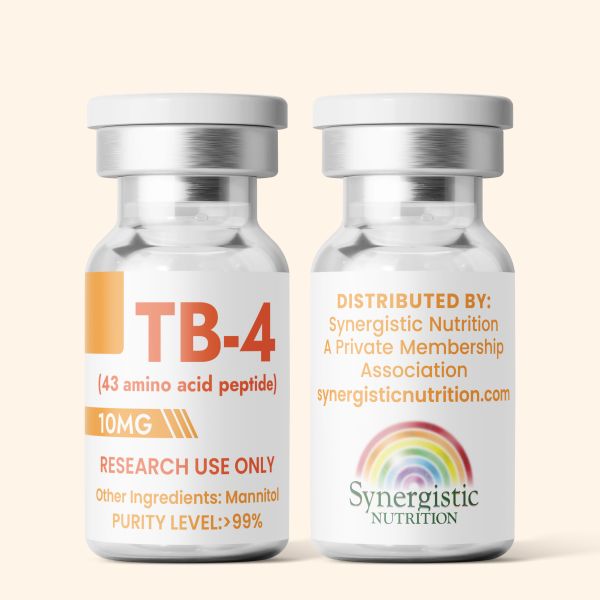
TB-4 - Thymosin Beta 4 (43 amino acid peptide) 10 mg vials
What TB-4 Is
- Thymosin Beta-4 (TB-4): A 43–amino acid peptide found in most tissues and cells, highly conserved across species.
- Belongs to the beta-thymosin family of actin-binding proteins.
- Widely distributed in platelets, macrophages, and many organs.
Biological Functions
TB-4 has many cellular roles, mainly related to actin dynamics (the cytoskeleton):
- Wound Healing & Tissue Repair
- Promotes cell migration (keratinocytes, endothelial cells, fibroblasts).
- Enhances angiogenesis (new blood vessel formation).
- Accelerates re-epithelialization after injury.
- Anti-inflammatory Effects
- Reduces levels of inflammatory cytokines (like TNF-α, IL-1β).
- Helps limit secondary tissue damage.
- Organ Protection
- Heart: shown in animal models to reduce myocardial infarct size and improve cardiac function.
- Brain: may reduce neuronal death after stroke or traumatic brain injury.
- Kidneys & lungs: preclinical data suggest anti-fibrotic and protective effects.
- Stem Cell Recruitment
- Attracts progenitor and stem cells to sites of injury.
- Supports regenerative processes in damaged tissues.
Clinical / Research Uses
- Wound healing: Topical and injectable TB-4 has been studied for burns, corneal injuries, chronic ulcers.
- Cardiac repair: Investigated in myocardial infarction models.
- Neurological repair: Animal models of stroke, TBI, multiple sclerosis shows some benefit.
- Ophthalmology: TB-4 derivatives studied for dry eye and corneal damage.
TB-4 vs TB-500
- TB-4 = natural full-length peptide (43 amino acids).
- TB-500 = synthetic fragment of TB-4 (17 amino acids, from the central actin-binding domain).
- TB-500 is more widely available commercially as a research peptide, easier to synthesize, and often used experimentally for regenerative / performance purposes.
Safety & Status
- Naturally present in the body (endogenous).
- No FDA approval as a drug.
- Preclinical and some early clinical studies show safety, but therapeutic use remains experimental.
Summary:
Thymosin Beta-4 (43 aa) is a naturally occurring peptide with strong roles in cell migration, wound healing, angiogenesis, anti-inflammation, and organ protection. It’s a key factor in tissue repair and regeneration. While promising in preclinical and some early human studies, it’s still not an approved therapy, but it laid the foundation for TB-500 and other therapeutic peptides.
Thymosin beta4 and cardiac repair
Hypoxic heart disease is a predominant cause of disability and death worldwide. As adult mammals are incapable of cardiac repair after infarction, the discovery of effective methods to achieve myocardial and vascular regeneration is crucial. Efforts to use stem cells to repopulate damaged tissue are currently limited by technical considerations and restricted cell potential. We discovered that the small, secreted peptide thymosin beta4 (Tbeta4) could be sufficiently used to inhibit myocardial cell death, stimulate vessel growth, and activate endogenous cardiac progenitors by reminding the adult heart on its embryonic program in vivo. The initiation of epicardial thickening accompanied by increase of myocardial and epicardial progenitors with or without infarction indicate that the reactivation process is independent of injury. Our results demonstrate Tbeta4 to be the first known molecule able to initiate simultaneous myocardial and vascular regeneration after systemic administration in vivo. Given our findings, the utility of Tbeta4 to heal cardiac injury may hold promise and warrant further investigation.[1]
Thymosin Beta 4 10mg 99% purity, plus mannitol as a safe filler.
For Research Purposes Only.
Typical Duration and Cycle Length
|
Purpose / Goal |
Typical Duration |
Notes |
|
Acute injury or surgery recovery |
4–6 weeks |
Used daily or every other day until healing is complete. |
|
Chronic injury / tissue repair (tendons, ligaments, etc.) |
6–8 weeks |
May extend up to 12 weeks depending on tissue response. |
|
General regeneration / anti-aging support |
4–6 weeks on, followed by 4–6 weeks off |
Often cycled rather than continuous to avoid desensitization. |
|
Performance / muscle recovery |
4 weeks |
Usually paired with rest and nutrition for best results. |
Typical Dosing Frequency (for context)
- Initial phase (loading): 2–5 mg twice per week for the first 4–6 weeks.
- Maintenance phase (optional): 2 mg once per week or every other week.
(Exact dose varies by body weight, condition, and purity of product.)
When to Stop or Pause
- When pain, inflammation, or injury symptoms resolve.
- If no improvement is noticed after ~8 weeks.
- If any adverse effects occur (rare but can include mild fatigue or headache).
- Many practitioners recommend taking at least equal time off between cycles.
Why Cycling Is Recommended
- TB-4 promotes tissue regeneration and angiogenesis (new blood vessels).
- These processes slow down naturally once healing is achieved, so continuous use offers little added benefit.
- Cycling gives the body time to rebalance natural repair mechanisms.
Important Notes
- Store reconstituted TB-4 in the refrigerator (2–8 °C).
- Discard after ~30 days to avoid contamination.
- Always use sterile injection practices and consult a qualified professional before starting any peptide regimen.
Would you like me to outline a sample 6-week TB-4 protocol (dosing schedule + injection frequency) for injury recovery or regeneration purposes? It makes the timeline much easier to follow.
Product Reviews
No reviews available for this product.
